
Maine Coon Kitten Growth Chart: How Big Will Your Maine Coon Become?
Published on August 30, 2026 • Written by Kitten Kingdom Expert • 5 min read
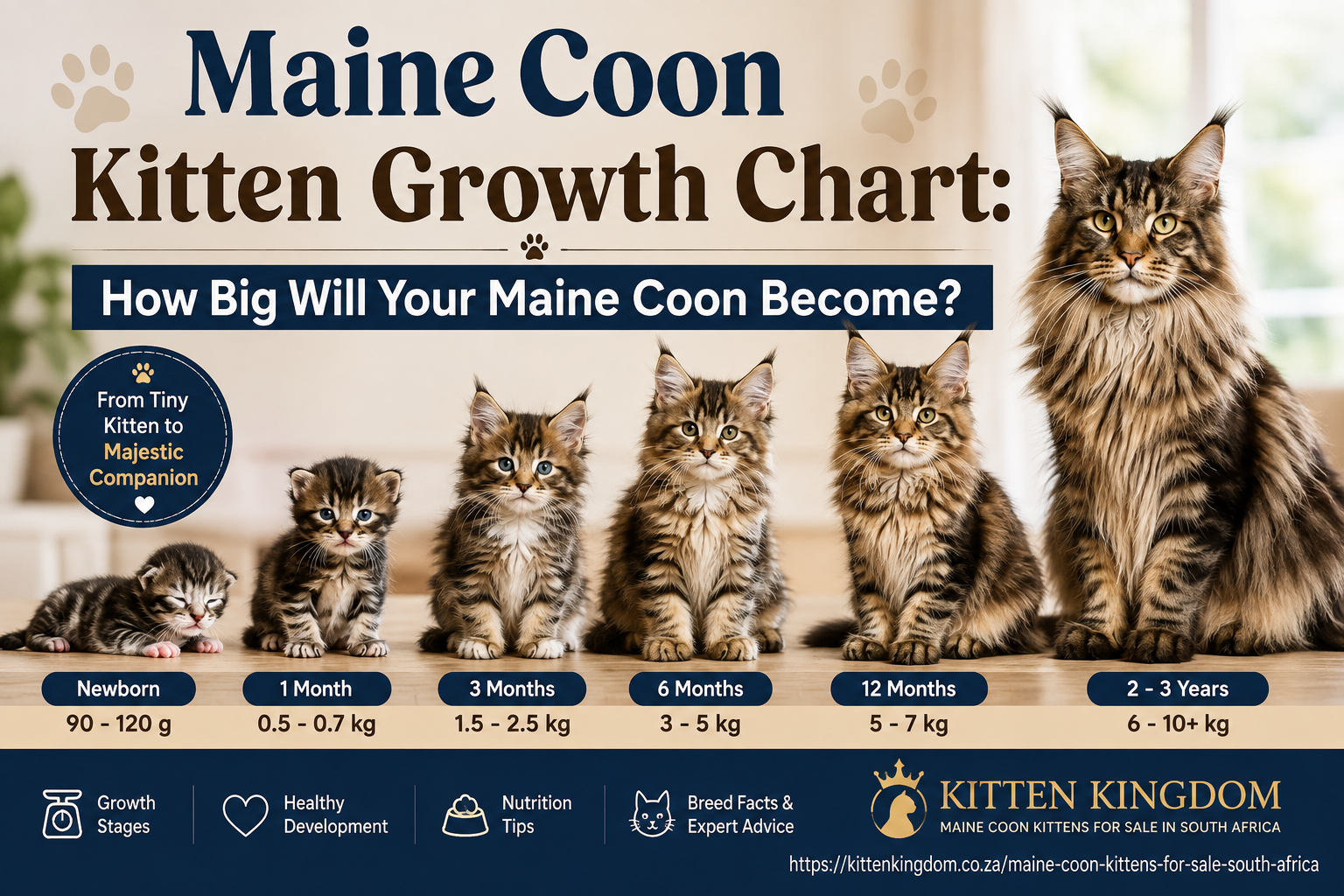
Maine Coon cats are famous for their impressive size, luxurious coats, long bodies and gentle personalities. If you are considering bringing one home, one of the most common questions is: how big will my Maine Coon kitten become?
Unlike many domestic cats, Maine Coons are slow-growing and can continue developing well beyond their first year. Understanding a Maine Coon kitten growth chart can help owners monitor development, recognize normal growth patterns and provide appropriate nutrition throughout kittenhood.
According to the Cat Fanciers' Association (CFA), Maine Coons are a slow-maturing breed and may take up to three years to reach full growth. Mature males can reach or exceed 20 pounds, while females are generally smaller.
If you are researching kittens before choosing one, you can also explore Maine Coon kittens for sale in South Africa to learn more about available kittens and the breed.
Maine Coon Kitten Growth at a Glance
Maine Coon kittens generally grow steadily during their first year and then continue filling out as their bones, muscles and body proportions mature.
The following table is a general guide rather than a strict medical growth standard. Individual Maine Coons can be considerably smaller or larger depending on genetics, sex, nutrition, health and other factors.
AgeTypical DevelopmentBirthVery small, dependent on mother1 monthRapid physical and neurological development2 monthsActive, playful and increasingly independent3 monthsNoticeable growth in body, legs and paws4–6 monthsStrong growth and increasing muscle development6–9 monthsLarger frame becomes increasingly apparent9–12 monthsApproaching a substantial juvenile size12–18 monthsContinued body and muscle development18–24 monthsGradual filling out and maturation24–36 monthsMany Maine Coons approach mature development
Remember that weight alone does not determine whether a Maine Coon is developing correctly. Body length, bone structure, muscle condition and overall health are also important.
How Big Do Maine Coon Cats Get?
Maine Coons are among the largest pedigreed cat breeds. The CFA describes the breed as large, rugged and slow-maturing. It notes that males average around 12–15 pounds (5.4–6.8 kg), with some reaching 20 pounds or more, while females average around 9–12 pounds (4.1–5.4 kg).
However, these figures should not be treated as a target weight for every cat.
A healthy Maine Coon may be:
- Smaller than the breed average
- Close to the average
- Larger than the average
- Heavier because of body frame and musculature
- Lighter while still being perfectly healthy
Size should never be the only measure of quality or health. The CFA breed standard specifically emphasizes proportion and balance rather than simply pursuing maximum size.
Male vs Female Maine Coon Growth
One of the biggest factors influencing adult size is sex.
Male Maine Coon
Male Maine Coons are generally larger and heavier than females. They often develop:
- Larger heads
- Broader chests
- Heavier bone structure
- Greater muscle mass
- Longer, more substantial bodies
A mature male can sometimes exceed 20 pounds, although exceptionally large cats should not be considered the standard that every male should reach.
Female Maine Coon
Females are generally smaller but can still become remarkably large compared with many other domestic cats.
Female Maine Coons commonly have:
- Long bodies
- Large paws
- Strong bone structure
- A substantial coat
- A graceful but muscular appearance
The CFA notes that females are generally smaller than males.
Maine Coon Growth Stages
0–3 Months: Rapid Early Development
The first few months are a critical period for kitten development.
During this stage, kittens learn to:
- Walk and coordinate their movements
- Eat solid food
- Use a litter box
- Interact socially
- Play and explore their environment
By around three months, the differences between Maine Coon kittens and smaller cat breeds can become increasingly noticeable.
Their oversized paws, long legs and developing bodies are some of the features that make Maine Coon kittens so distinctive.
3–6 Months: Noticeable Growth
Between three and six months, many Maine Coon kittens experience significant physical development.
You may notice:
- Rapid increases in length
- Larger paws
- A longer tail
- Increasing muscle
- Developing facial structure
- More substantial coat growth
This is also an excellent period for establishing healthy feeding, grooming and veterinary routines.
Owners should avoid attempting to make a kitten grow faster through excessive feeding. Healthy, controlled growth is more important than maximum weight.
6–12 Months: The Juvenile Growth Phase
At six months and beyond, a Maine Coon may already look impressively large compared with an average domestic kitten.
However, reaching a substantial juvenile size does not mean the cat has finished growing.
During the remainder of the first year, Maine Coons may continue developing their:
- Body length
- Chest width
- Muscle mass
- Head shape
- Coat
- Tail length and fullness
This is one reason Maine Coon owners need to think about growth over several years rather than expecting their kitten to reach adult proportions at 12 months.
12–24 Months: Continued Development
Many cat owners are surprised to discover that a one-year-old Maine Coon can still have considerable growing to do.
The breed is recognized for its slow maturation, with full development potentially taking around three years.
During the second year, your Maine Coon may gradually become:
- Heavier
- More muscular
- Broader through the chest
- More developed around the head and muzzle
- Fuller-coated
Growth may also become less dramatic than during kittenhood.
24–36 Months: Reaching Mature Size
By approximately two to three years, many Maine Coons are approaching their mature physical development.
Some individuals may continue filling out beyond this period.
The CFA specifically describes Maine Coon cats as slow to mature, with some taking three to four years for full development.
This extended maturation period is one of the defining characteristics of the breed.
What Factors Determine Maine Coon Size?
A Maine Coon kitten growth chart can provide useful expectations, but genetics and individual development ultimately determine how large your cat will become.
1. Genetics
Genetics play an enormous role in determining adult size.
The kitten's parents can provide useful clues about:
- Expected body size
- Bone structure
- Body length
- Growth pattern
- Adult weight
However, even kittens from the same litter can mature differently.
2. Sex
Males are generally larger than females, although there is considerable individual variation.
3. Nutrition
A balanced diet provides the nutrients necessary for healthy bone, muscle and tissue development.
Kittens should receive food formulated for their developmental stage rather than being deliberately overfed to encourage rapid growth.
4. Overall Health
Illness, parasites, nutritional deficiencies and other health problems can affect growth.
Regular veterinary examinations are therefore an important part of monitoring a growing Maine Coon.
5. Exercise and Activity
Maine Coons are active cats that benefit from opportunities to climb, play and explore.
Appropriate activity helps support healthy muscle development and keeps growing kittens mentally stimulated.
How to Tell if Your Maine Coon Kitten Is Growing Properly
Instead of focusing exclusively on the number on a scale, look at the kitten as a whole.
Signs of healthy development may include:
- Consistent growth
- Good appetite
- Bright, alert behavior
- Healthy coat
- Normal energy levels
- Strong muscle development
- Good body condition
- Regular veterinary assessments
Your veterinarian can determine whether your kitten's weight and body condition are appropriate for its age, sex and individual circumstances.
Don't Compare Littermates Too Closely
Two Maine Coon kittens of the same age can have different growth patterns.
One may become a particularly large adult while another remains more moderate in size.
That does not automatically mean that one is healthier.
Does a Bigger Maine Coon Mean a Healthier Maine Coon?
No.
This is an important point for prospective owners.
Maine Coon cats are naturally large, but deliberately encouraging excessive weight gain is not the same as supporting healthy development.
The CFA breed standard emphasizes balance and proportion, and notes that quality should not be sacrificed for size.
A healthy Maine Coon should have an appropriate body condition rather than simply being as heavy as possible.
Maine Coon Size and Nutrition
Nutrition is especially important during the extended growth period.
A growing Maine Coon needs an appropriately balanced diet containing the nutrients required for development. Feeding should be based on the kitten's age, body condition, activity level and veterinary guidance.
Avoid:
- Overfeeding simply to create a larger cat
- Abrupt diet changes
- Unbalanced homemade diets
- Excessive treats
- Using adult cat food as a substitute for an appropriate kitten diet without professional guidance
Fresh water should also be available at all times.
If your kitten's weight suddenly increases or decreases, discuss the change with your veterinarian rather than attempting to correct it yourself.
Maine Coon Growth and Grooming
Growth is not limited to bones and muscles. Your kitten's famous long coat also changes considerably as it matures.
Maine Coon cats develop a thick, flowing coat that is shorter around the shoulders and longer around areas such as the stomach, britches and tail.
Regular grooming helps prevent:
- Mats
- Tangled fur
- Excessive loose hair
- Hairballs
The CFA recommends combing Maine Coons approximately two or three times per week.
When Should You Expect Your Maine Coon to Stop Growing?
Unlike many domestic cats that reach most of their adult size relatively early, Maine Coons mature slowly.
A Maine Coon may continue developing until approximately three years old, with some individuals taking even longer to fully mature.
Therefore, if your 12-month-old Maine Coon does not yet look like a huge adult cat, there is usually no reason to assume that growth is finished.
Frequently Asked Questions About Maine Coon Growth
How fast do Maine Coon kittens grow?
Maine Coon kittens grow rapidly during early kittenhood, but their overall maturation is unusually slow. They can continue developing well beyond their first birthday and may reach full development around three years of age.
What is the average weight of a Maine Coon?
CFA lists mature males at approximately 12–15 pounds on average, with some reaching 20 pounds or more. Females average approximately 9–12 pounds.
Can a Maine Coon weigh more than 20 pounds?
Yes, some mature males can reach or exceed 20 pounds. However, extremely high weight should not automatically be considered desirable. Body condition and overall health are more important than chasing a particular number.
Do male Maine Coons grow bigger than females?
Generally, yes. Male Maine Coons tend to be larger and heavier than females, although individual variation can be significant.
Are Maine Coons fully grown at one year?
Usually not. Maine Coons are slow-maturing cats and can continue developing for several years.
How can I estimate my kitten's adult size?
Your kitten's parents can provide useful clues, particularly when combined with information about the kitten's current growth pattern. However, no growth chart can predict an individual cat's final size with complete accuracy.
Choosing a Maine Coon Kitten in South Africa
If you are planning to purchase a Maine Coon kitten, look beyond size alone.
A responsible breeder should be able to provide information about the kitten's:
- Parents
- Age
- Health history
- Vaccination status
- Deworming
- Feeding routine
- Socialization
- Pedigree, where applicable
- Veterinary care
It is also worthwhile asking questions about the parents' health and any breed-relevant screening performed by the breeder. The CFA notes that breeders use measures such as hip-dysplasia evaluation and testing related to hypertrophic cardiomyopathy as part of responsible Maine Coon health management.
For prospective owners researching their options, Maine Coon kittens for sale in South Africa can be a useful starting point when comparing available kittens.
Maine Coon Kitten Growth Chart: Key Takeaways
The most important things to remember are:
- Maine Coons are slow-maturing cats.
- Males are generally larger than females.
- Adult males may reach or exceed 20 pounds.
- Females are typically smaller but remain large cats.
- Growth can continue for approximately three years.
- Genetics strongly influence adult size.
- Healthy nutrition is more important than maximizing weight.
- Body condition matters more than a single number on the scale.
- Regular veterinary care helps monitor healthy development.
- A reputable breeder should prioritize health and temperament rather than size alone.
If you are looking for a Maine Coon kitten and want to learn more about available options in South Africa, visit Maine Coon kittens for sale in South Africa.
Final Thoughts
Watching a Maine Coon kitten grow into a magnificent adult cat is one of the most rewarding parts of owning this breed. Their development is different from that of many other cats because they mature slowly and can continue developing for several years.
Rather than focusing exclusively on how many kilograms your kitten gains each month, pay attention to steady growth, healthy body condition, nutrition, activity, grooming and veterinary care.
Whether your Maine Coon eventually becomes a moderately sized female or an exceptionally large male, the goal should always be the same: a healthy, well-proportioned and happy companion.
For those researching their next kitten, Maine Coon kittens for sale in South Africa provides another resource for exploring Maine Coon kittens and learning more about the breed.
SEO Tip: For best results, use “Maine Coon kitten growth chart” as the primary focus keyword, with related terms such as “Maine Coon adult size,” “Maine Coon kitten weight,” “how big do Maine Coon cats get,” and “Maine Coon kittens for sale South Africa” naturally throughout the page.