
Persian Kittens for Sale in South Africa: A Complete Buyer’s Guide
Published on September 30, 2026 • Written by Kitten Kingdom Expert • 10 min read
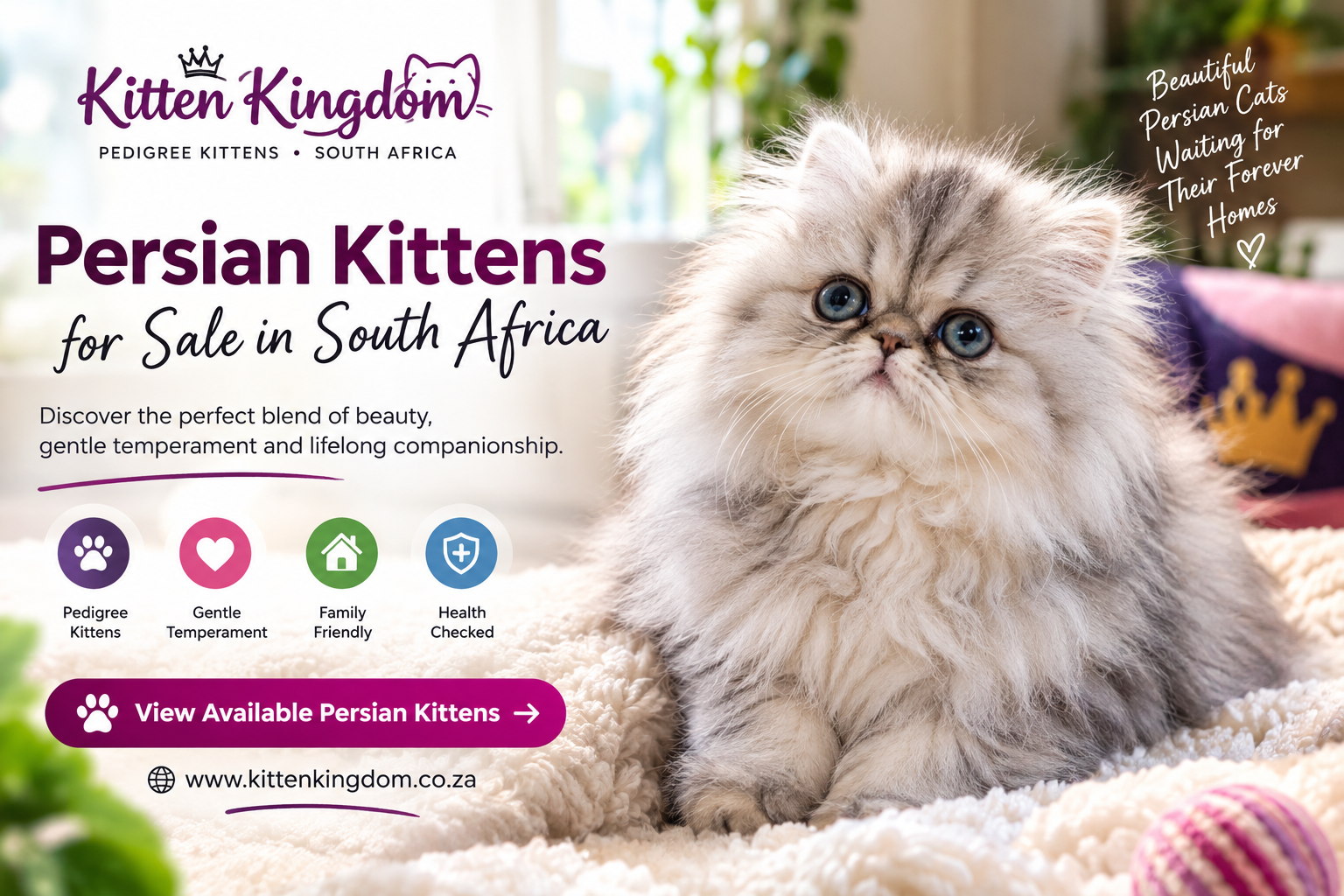
If you are searching for Persian kittens for sale in South Africa, choosing the right kitten involves more than simply finding a beautiful long-haired cat. Persian cats are known for their luxurious coats, expressive round eyes, gentle personalities and distinctive appearance, but they also require committed grooming, responsible breeding and attentive lifelong care.
Whether you are looking for a Persian kitten as a family companion, an indoor pet or a pedigree addition to your home, it is important to understand the breed before making a decision.
At Kitten Kingdom, families searching for pedigree kittens in South Africa can explore breed information and current kitten availability, including our dedicated Persian kittens for sale in South Africa page.
Table of Contents
- Why Persian Cats Are So Popular
- What Does a Persian Cat Look Like?
- Persian Kitten Personality and Temperament
- Are Persian Kittens Good Family Pets?
- Persian Kittens and Children
- Persian Cats and Other Pets
- Persian Kitten Grooming Requirements
- Feeding a Persian Kitten
- Persian Cat Health Considerations
- Questions to Ask a Persian Kitten Breeder
- How to Choose a Healthy Persian Kitten
- Persian Kitten Prices in South Africa
- Preparing Your Home for a Persian Kitten
- Persian Kittens as Indoor Cats
- Why Responsible Breeding Matters
- Finding Persian Kittens for Sale in South Africa
- Frequently Asked Questions
- Final Thoughts
Why Persian Cats Are So Popular
The Persian is one of the world's best-known pedigree cat breeds. Its distinctive combination of a rounded head, large expressive eyes, short nose, substantial body and long, full coat gives the breed an unmistakable appearance. The Cat Fanciers' Association describes the Persian as a long-haired breed with a stocky body, broad face and sweet, affectionate and quiet personality.
For many South African cat lovers, the appeal of a Persian goes beyond appearance.
Persians are generally associated with:
- Calm personalities
- Affectionate behaviour
- Luxurious coats
- Large expressive eyes
- A relatively quiet nature
- Indoor companionship
- A relaxed lifestyle
- Strong attachment to their owners
If you are looking for a companion that is generally more interested in relaxing beside you than constantly climbing around the house, the Persian may be worth considering.
However, their beautiful coat and distinctive facial structure also mean that prospective owners need to understand the breed's specific care requirements.
What Does a Persian Cat Look Like?
A Persian kitten can look remarkably different from other domestic cats.
The traditional Persian appearance includes a rounded head, large round eyes, small rounded ears, short broad nose, full cheeks, short thick legs and a substantial body. The breed has a long, dense coat that contributes significantly to its characteristic appearance.
Persians can also occur in many colours and patterns.
Depending on the breeding line, you may encounter Persian kittens with colours or patterns including:
- White
- Black
- Blue
- Cream
- Red
- Chocolate
- Lilac
- Silver
- Golden
- Tabby
- Tortoiseshell
- Calico
- Bi-colour
- Pointed patterns
The Cat Fanciers' Association recognises numerous Persian colour divisions and patterns.
This variety is one reason families can have very different preferences when searching for a Persian kitten for sale in South Africa.
Persian Kitten Personality and Temperament
One of the biggest attractions of the Persian is its temperament.
Persians are commonly described as gentle, affectionate and relatively quiet. The CFA describes them as playful but placid and notes that they generally prefer receiving attention from their people rather than constantly seeking adventure.
A well-socialised Persian kitten may enjoy:
- Sitting beside its owner
- Relaxing on furniture
- Gentle interactive play
- Being stroked
- Quiet household routines
- Sleeping in comfortable areas
- Spending time with family members
This does not mean every Persian has exactly the same personality. Individual temperament depends on genetics, early socialisation, environment and handling.
A responsible breeder should therefore focus not only on appearance but also on producing kittens with good overall temperament and appropriate socialisation.
Are Persian Kittens Good Family Pets?
Persian cats can be excellent companions for households that understand their needs.
They are particularly appealing to people who enjoy a quieter indoor lifestyle and want an affectionate companion rather than a highly active cat.
However, families should understand that Persian ownership involves ongoing maintenance.
The most obvious responsibility is grooming.
Their long coat can develop tangles and mats if it is not maintained properly. The CFA specifically recommends regular combing and notes that Persian owners should be prepared for significant grooming requirements.
Before purchasing a Persian kitten, ask yourself:
Do I have enough time to groom my cat regularly?
If the answer is yes, a Persian can be a rewarding companion.
Persian Kittens and Children
Persians can live successfully with families, but children should be taught how to handle cats appropriately.
A kitten should never be pulled by its tail, squeezed, chased around the house or disturbed while eating or sleeping.
Instead, children should learn to:
- Stroke the kitten gently
- Allow the kitten to approach them
- Respect its sleeping area
- Avoid rough handling
- Play using appropriate cat toys
- Wash their hands after handling litter
- Give the kitten space when it wants to retreat
The CFA notes that Persians' calm temperament can allow them to coexist peacefully with children and other pets.
Nevertheless, individual personality matters. Young children should always be supervised around a new kitten.
Persian Cats and Other Pets
If you already have another cat or a dog, introducing a Persian kitten should be done gradually.
Do not simply place a new kitten directly into the middle of an established pet's territory.
A better introduction can involve:
Step 1: Separate spaces
Give your new Persian kitten a quiet room where it can become comfortable.
Step 2: Exchange scents
Allow the existing pet to smell bedding or other items associated with the kitten.
Step 3: Controlled visual introduction
Allow the animals to see each other without immediately forcing physical interaction.
Step 4: Short supervised meetings
Gradually increase the amount of time they spend together.
Step 5: Allow the relationship to develop naturally
Some cats become friends quickly, while others simply learn to coexist peacefully.
The goal should be a calm relationship rather than forcing the animals to interact.
Persian Kitten Grooming Requirements
Grooming is one of the most important considerations when buying a Persian kitten.
That beautiful long coat does not maintain itself.
Persian cats have long, dense coats that can become tangled or matted. Regular grooming is therefore essential. Veterinary guidance also identifies Persian cats as a long-haired breed requiring regular coat care.
A Persian grooming routine may include:
- Regular combing
- Checking for mats
- Gentle face cleaning
- Eye-area cleaning where necessary
- Nail trimming
- Bathing when appropriate
- Regular professional grooming if required
Starting grooming routines while your Persian is young can make the process considerably easier later.
The CFA recommends introducing kittens to grooming early because Persians require substantial coat maintenance.
Grooming tip
Do not wait until a kitten develops severe mats before introducing grooming.
Short, positive grooming sessions from an early age can help your Persian learn that brushing is a normal part of life.
Feeding a Persian Kitten
A Persian kitten requires a nutritionally complete diet appropriate for its age and individual needs.
Rather than choosing food solely because it is marketed specifically for Persian cats, discuss nutrition with your veterinarian.
The appropriate diet can depend on factors such as:
- Age
- Weight
- Activity level
- Growth requirements
- Health history
- Body condition
- Individual dietary needs
Veterinary nutritional guidance recommends basing dietary decisions on the individual cat and discussing nutrition with a veterinary healthcare team.
Fresh drinking water should also be available at all times.
Avoid making major dietary changes suddenly. If you need to change your kitten's food, transitioning gradually can help reduce digestive upset.
Persian Cat Health Considerations
Responsible Persian ownership includes understanding breed-associated health considerations.
This does not mean that every Persian kitten will develop health problems. It does mean that prospective owners should ask breeders meaningful questions about health testing and veterinary care.
Brachycephalic Features
Persians have a shortened facial structure, commonly described as brachycephalic.
Veterinary sources note that brachycephalic cats can have anatomical features that affect breathing, and Persian cats are among the breeds commonly associated with these concerns.
Owners should therefore pay attention to signs such as:
- Persistent noisy breathing
- Difficulty breathing
- Excessive overheating
- Poor exercise tolerance
- Breathing through the mouth
- Significant respiratory distress
If you notice concerning symptoms, seek veterinary attention.
South African climate
This consideration can be particularly relevant in warmer parts of South Africa.
Persian owners should provide:
- Fresh water
- Cool indoor areas
- Shade
- Good ventilation
- Appropriate temperature control during very hot weather
Veterinary guidance specifically recommends keeping short-snouted pets cool and providing access to water and cooling when temperatures rise.
Polycystic Kidney Disease and Persian Cats
Another important subject for prospective Persian owners is polycystic kidney disease (PKD).
PKD is an inherited condition involving cysts in the kidneys. Veterinary information identifies Persian cats as a breed with a significant association with PKD and notes that genetic testing is available.
This is one reason responsible breeding matters.
When considering a pedigree Persian kitten, ask the breeder about:
- Parent health history
- Genetic testing
- Veterinary examinations
- Vaccinations
- Parasite prevention
- Any known hereditary conditions in the breeding lines
A breeder should be comfortable discussing health rather than focusing exclusively on the kitten's colour and appearance.
Questions to Ask a Persian Kitten Breeder
Before purchasing a Persian kitten, ask plenty of questions.
A reputable breeder should be willing to explain how the kittens are raised and cared for.
Ask about the parents
Find out:
- Can I see photographs or meet the parents?
- What is their health history?
- Have relevant genetic tests been performed?
- What are their temperaments?
Ask about the kitten
Find out:
- How old is the kitten?
- Has it been examined by a veterinarian?
- Which vaccinations has it received?
- Has it received parasite treatment?
- What food is it currently eating?
- How has it been socialised?
- Has it been introduced to grooming?
Ask for documentation
Depending on the breeder and kitten, relevant documentation may include:
- Veterinary records
- Vaccination information
- Health information
- Pedigree documentation where applicable
- Microchip information where applicable
- Purchase agreement
Be cautious if a seller refuses to provide reasonable information or pressures you into making an immediate payment.
How to Choose a Healthy Persian Kitten
When viewing a Persian kitten, look beyond colour and appearance.
A healthy kitten should generally appear alert, appropriately active for its age and comfortable interacting with its surroundings.
Look for:
Clear eyes
The eyes should be checked for excessive discharge, significant redness or obvious irritation.
Clean nose
Pay attention to unusual nasal discharge or obvious breathing difficulties.
Healthy coat
The coat should be reasonably clean and free from severe matting or obvious parasite problems.
Good body condition
The kitten should not appear extremely thin or excessively overweight.
Normal behaviour
A kitten should show an appropriate level of curiosity and interaction for its age.
Clean environment
The surroundings where kittens are raised can tell you a great deal about the breeder's approach to care.
Remember that visual inspection cannot replace a veterinary examination.
Persian Kitten Prices in South Africa
One of the most common questions buyers ask is:
"How much does a Persian kitten cost in South Africa?"
There is no single price that applies to every Persian kitten.
Prices can vary according to factors such as:
- Pedigree
- Bloodline
- Colour
- Breeder reputation
- Registration
- Health testing
- Vaccination status
- Veterinary care
- Age
- Socialisation
- Location
- Included documentation
Instead of choosing a kitten purely because it has the lowest advertised price, consider the total value of responsible breeding and appropriate early care.
A very inexpensive kitten may not necessarily represent the lowest overall cost if important veterinary care, preventative treatments or responsible breeding practices have been overlooked.
Preparing Your Home for a Persian Kitten
Before your kitten arrives, prepare a dedicated area.
You may need:
- Food and water bowls
- Kitten food
- Litter tray
- Cat litter
- Comfortable bed
- Scratching post
- Safe toys
- Grooming comb
- Cat carrier
- Blanket
- Safe hiding area
You should also kitten-proof the home.
Remove or secure:
- Electrical cables
- Toxic plants
- Small objects
- Open windows
- Accessible chemicals
- Unsecured balconies
- Dangerous gaps
A new kitten should initially have a safe, quiet area where it can become familiar with its new surroundings.
Persian Kittens as Indoor Cats
Persians are particularly well suited to an indoor lifestyle when their physical, mental and social needs are met.
Their long coats require considerable maintenance, and their flat facial structure can make environmental management particularly important.
International Cat Care identifies Persian cats among breeds whose long hair requires regular human grooming and also highlights the special considerations associated with brachycephalic cats.
An indoor Persian should still have opportunities for:
- Interactive play
- Scratching
- Climbing where safe
- Exploring
- Window watching
- Mental stimulation
- Human interaction
An indoor lifestyle should not mean an inactive lifestyle.
Why Responsible Breeding Matters
When searching for Persian kittens for sale in South Africa, responsible breeding should be one of your biggest considerations.
A responsible breeder should care about more than producing kittens with attractive faces and beautiful coats.
Important considerations include:
Health
Breeding cats should receive appropriate veterinary attention and relevant health screening.
Temperament
Kittens should be raised with appropriate handling and socialisation.
Genetics
Breeders should understand hereditary conditions associated with the breed.
Environment
Kittens should be raised in a clean, safe and appropriate environment.
Transparency
The breeder should be willing to answer reasonable questions about the kitten and its parents.
Responsible breeding is ultimately about producing kittens with the best possible foundation for a healthy life.
Finding Persian Kittens for Sale in South Africa
If you are ready to begin your search, start by researching the breed rather than immediately sending money to the first advertisement you find.
You can explore the dedicated Persian kittens available in South Africa section on Kitten Kingdom for information relevant to prospective owners.
If you are still deciding which breed suits your lifestyle, you can also explore available pedigree kittens in South Africa.
Kitten Kingdom also provides information about other popular breeds, including:
- Maine Coon kittens for sale in South Africa
- Ragdoll kittens for sale in South Africa
- Bengal kittens for sale in South Africa
- British Shorthair kittens in South Africa
- Birman kittens for sale in South Africa
- Sphynx kittens for sale in South Africa
- Siamese kittens for sale in South Africa
These internal links can also help visitors compare breeds before deciding which type of kitten best fits their home.
Persian vs Other Popular Pedigree Cats
If you are unsure whether a Persian is the right choice, comparing breeds can be useful.
Persian vs British Shorthair
Persians generally require substantially more grooming because of their long coats, while British Shorthairs have a shorter, dense coat.
You can learn more in our guide to British Shorthair kittens in South Africa.
Persian vs Ragdoll
Both breeds are popular with families seeking affectionate companion cats, but their appearance, coat characteristics and personalities differ.
Read more about Ragdoll kittens for sale in South Africa before deciding.
Persian vs Maine Coon
Maine Coons are substantially larger and have a very different body structure and temperament from Persians.
If you are considering a larger pedigree cat, explore Maine Coon kittens in South Africa.
Frequently Asked Questions About Persian Kittens
Are Persian kittens good pets?
Persian cats can make affectionate and calm companions, particularly for households that can provide regular grooming and appropriate indoor care. Individual temperament varies between cats.
How often should I groom a Persian kitten?
Persian coats require regular grooming to prevent tangles and mats. Establishing a grooming routine while the kitten is young can make lifelong coat care easier.
Are Persian cats good with children?
They can live successfully with children, particularly when children are taught to handle cats gently and respectfully. Supervision is important with young children.
Do Persian cats need to live indoors?
Persians can thrive indoors when they receive adequate exercise, enrichment, grooming and human interaction. Their long coats and flat facial structure also make appropriate environmental management important.
Are Persian cats expensive to maintain?
They can require more maintenance than short-haired cats because of grooming, veterinary care and other breed-specific needs. Prospective owners should consider ongoing costs rather than only the initial kitten price.
Do Persian cats have health problems?
Persian cats can be predisposed to certain hereditary and conformational health concerns. Responsible breeding, appropriate health screening and regular veterinary care are important.
What should I ask a Persian kitten breeder?
Ask about the kitten's veterinary history, vaccinations, parasite prevention, parents, health screening, socialisation, diet and available documentation.
Where can I find Persian kittens for sale in South Africa?
You can start your search through the Kitten Kingdom Persian kitten page and research the breeder, kitten and health information carefully before making a purchase.
Final Thoughts: Choosing a Persian Kitten in South Africa
A Persian kitten can bring years of companionship, affection and enjoyment to the right household.
However, the decision should never be based solely on the kitten's appearance.
Before purchasing, consider the full commitment involved:
Grooming + nutrition + veterinary care + socialisation + safe housing + responsible breeding = responsible Persian ownership.
Take your time researching breeders, ask questions about health and genetics, meet the kitten where possible, review available documentation and make sure you understand the ongoing care requirements.
If your family is specifically looking for a beautiful long-haired companion, you can begin by exploring Persian kittens for sale in South Africa at Kitten Kingdom.
For families still deciding between breeds, browse pedigree kittens available in South Africa and compare the characteristics, grooming requirements and lifestyles associated with different breeds.